
Home Bitcoin Mining in 2026: 22% More Expected BTC per Hash

Data snapshot: September 16, 2026, 15:58 UTC.
Your Bitcoin miner does not have to get faster to become more productive. When network difficulty falls, the same hashrate can earn more bitcoin. Our comparison uses Bitcoin's actual difficulty adjustment history.
If you have been waiting for a sustained break from rising difficulty, now is a compelling time to start mining at home. Your existing hardware can do more with the same hashrate and uptime, and a new miner starts from a more favorable difficulty level than last autumn. Here is what that means for pool payouts and the chance of finding your own block.
Why lower Bitcoin mining difficulty means more BTC per hash
Bitcoin mining difficulty measures how hard it is to produce valid proof of work. The network adjusts it every 2,016 blocks to keep block production near its ten-minute target. When difficulty falls, each hash has a better chance of meeting the network's requirements. Bitcoin's proof-of-work guide explains the mechanism.
Our comparison uses the difficulty peak on October 29, 2025, and the difficulty in effect on September 16, 2026:
| Measure | October 2025 peak | September 2026 snapshot |
|---|---|---|
| Network difficulty | 155.973 trillion | 127.451 trillion |
| Expected subsidy yield per 1 TH/s per day | 40.30 sats | 49.32 sats |
| Expected subsidy yield relative to the peak | 100% | 122.4% |
The latest completed adjustment, on September 5, increased difficulty by 1.31%. Even after that increase, it remains 18.3% below the October 2025 record.
The calculation is simple: 155.973 ÷ 127.451 − 1 = 22.4%.
A decline in difficulty and an increase in mining yield use different denominators. That is why an 18.3% difficulty decline produces a 22.4% improvement in expected yield.
The table holds effective hashrate and uptime constant and uses the current 3.125 BTC block subsidy, excluding transaction fees, pool charges and operating costs. These are mathematical expectations; actual payouts depend on your mining arrangement and results. Bitcoin's subsidy schedule provides the reward baseline.
The longest stretch without a new difficulty high since 2012
The depth of the decline is only part of the opportunity. Its duration matters too.
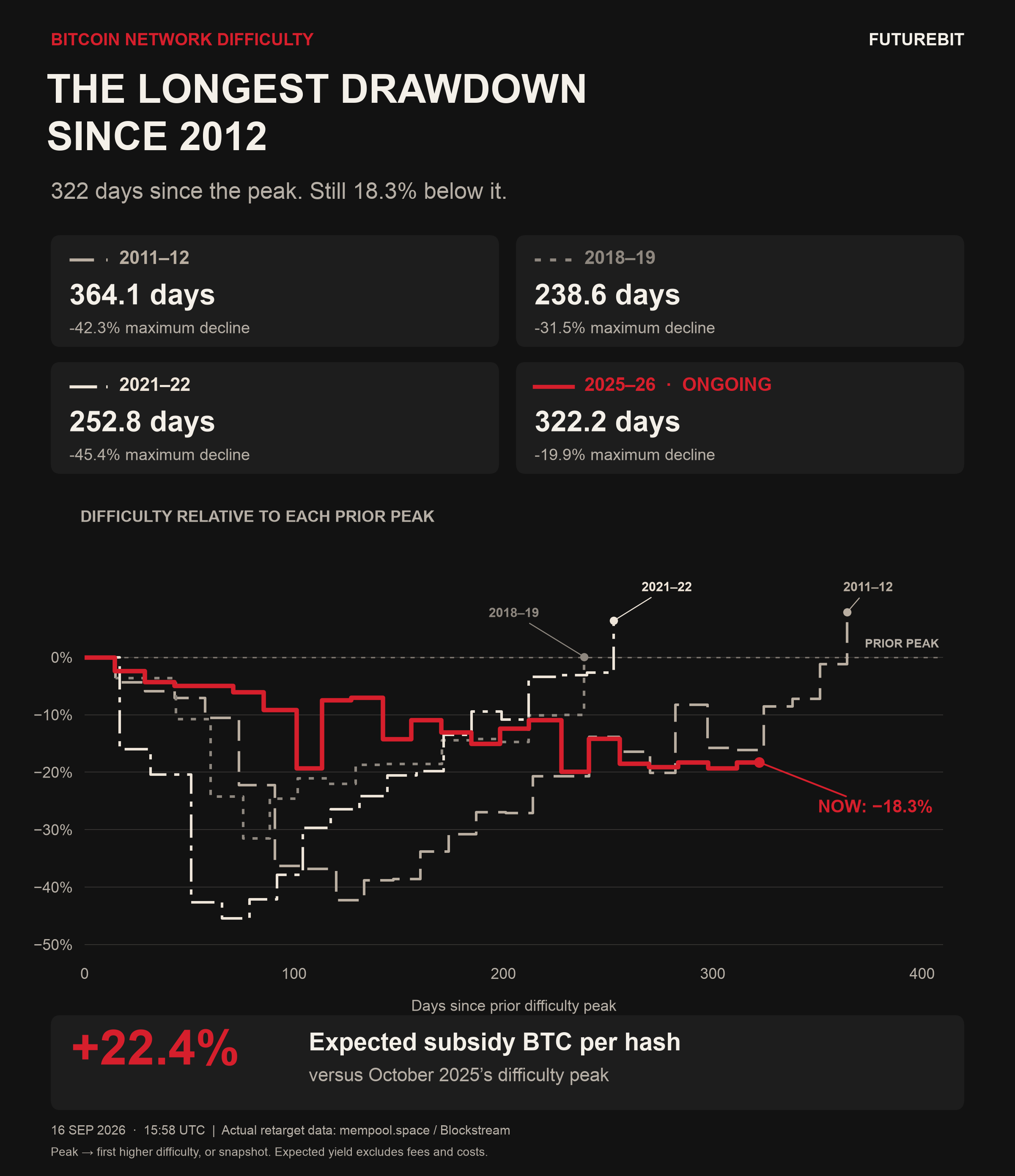
By our September 16 snapshot, 322.2 days had passed since Bitcoin's last difficulty all-time high. That exceeds both the 2018–19 and 2021–22 recovery periods. Only the 2011–12 episode lasted longer in the difficulty history we analyzed.
| Difficulty cycle | Time from peak to first new high | Maximum decline from peak |
|---|---|---|
| 2011–12 | 364.1 days | 42.3% |
| 2018–19 | 238.6 days | 31.5% |
| 2021–22 | 252.8 days | 45.4% |
| 2025–26 | 322.2 days and ongoing | 19.9% |
Calculated from network difficulty records. Each interval starts at the block that set the prior record and ends at the first higher difficulty, or the snapshot for the ongoing interval. It includes the initial adjustment period at the peak.
Difficulty has moved both up and down during this stretch. What makes it unusual is that those increases have repeatedly stopped short of a new record. Home miners have had a prolonged break from the pattern of successive difficulty highs reducing the expected bitcoin earned by unchanged hardware.
Large miners are redirecting power toward AI
There is also a reason to watch this cycle beyond the chart: some large operators are committing mining infrastructure to artificial intelligence.
IREN reached 50 EH/s of installed mining capacity in June 2025. Its June 2026 figure was 23.2 EH/s, a reduction of 26.8 EH/s. The company describes decommissioning mining hardware and reallocating power and facilities to AI services, targeting substantial completion by December 2026. Capacity announcement, annual report.
Cipher's Black Pearl site provides another example. It reported approximately 10.1 EH/s operating in September 2025, then stopped mining in February 2026 as the site shifted toward computing infrastructure for Amazon. Operating update, annual report.
Our view is that long-term commitments of power and facilities to AI can make a mining recovery more complicated. Machines can still move elsewhere, and new mining capacity can enter the network. The opportunity for home miners rests on today's lower difficulty, while these infrastructure decisions help explain why the broader trend deserves attention.
Pool mining: more expected satoshis from the same home miner
If your goal is to accumulate smaller amounts of bitcoin over time, pool mining lets you share in a pool's results according to your contributed work and its payout rules. It smooths the large swings involved in finding whole blocks yourself. Bitcoin's mining guide describes this tradeoff.
At today's difficulty, the subsidy component of your expected BTC earnings is roughly 22.4% higher than at the October 2025 peak, assuming the same hashrate, uptime and pool terms. Your miner does not need an upgrade to receive that mathematical benefit.
Lower difficulty benefits miners of every size. For a home miner, the appeal is that you can participate with equipment and a power budget that fit your household.
Your own economics still depend on electricity prices, hardware efficiency, purchase cost and pool fees. Bitcoin's market price affects the dollar value of your earnings. Check those inputs before starting or restarting a miner; more expected BTC per hash improves the calculation without guaranteeing a profit.
Lottery mining: about 22% better odds per hash
For a solo Bitcoin miner, lower difficulty improves the chance of finding a block with every hash attempted.
At our September snapshot, that probability is approximately 22.4% higher per hash than at the October 2025 peak. This is a relative improvement in your odds. A small home miner's absolute chance of finding a block remains small.
For example, a miner running continuously at 10 TH/s would have approximately these chances of finding at least one block over 365 days, if difficulty stayed fixed:
| Difficulty environment | Chance at 10 TH/s over 365 days |
|---|---|
| October 2025 peak | About 1 in 2,125 (0.0471%) |
| September 16, 2026 | About 1 in 1,736 (0.0576%) |
These calculated examples isolate the difficulty advantage. Real odds change with difficulty, effective hashrate and uptime. Each fresh hash is an independent attempt; previous misses do not make a win due.
The potential reward remains compelling: a successful accepted block currently carries a 3.125 BTC subsidy plus its transaction fees, before any solo-service fee. Solo mining trades regular shared payouts for that rare, much larger outcome. Reward schedule, solo mining mechanics.
That is the appeal of lottery mining at lower difficulty: you can use the same hardware, at the same hashrate, with meaningfully better odds on each attempt. Our solo Bitcoin mining guide explains the setup and the choice between solo and pool mining.
Bring Bitcoin mining home with FutureBit
We build FutureBit products so individuals can participate directly in Bitcoin. This difficulty window makes that participation more attractive, whether you want to mine through a pool or build a setup around your own node.
| Your starting point | FutureBit setup | What it provides |
|---|---|---|
| You want a miner and node together | Apollo III Full Node | A Bitcoin miner, full node and built-in solo server; pool or solo mining, up to 18 TH/s depending on mode and settings |
| You want a standalone home miner | Apollo III Standard | Hashing hardware with its own controller, ready for a pool or your existing solo endpoint |
| You already own mining hardware | FutureBit Solo Node | A full node and solo server; your connected external miners supply the hashrate |
Our external miner connection guide explains how to connect your existing miners to your own solo setup.
You can choose the kind of mining experience you want: pool participation for smaller, more regular payouts, or solo mining for the possibility of producing a block yourself.
Today's lower difficulty gives your hashrate more expected subsidy bitcoin per hash than at last autumn's peak. Put it to work on your terms. Explore Apollo III.
Home Bitcoin mining FAQ
Is 2026 a good time to start mining Bitcoin at home?
From a difficulty perspective, September 2026 offers a favorable entry point compared with October 2025. Expected subsidy earnings per unit of hashing are about 22.4% higher. Whether it makes financial sense for you depends on your equipment, electricity costs and mining goals.
Does lower difficulty increase solo mining odds?
Yes. Lower difficulty makes each hash more likely to satisfy Bitcoin's proof-of-work requirement. At the September 16 snapshot, the improvement is approximately 22.4% per hash compared with the October 2025 peak.
Why does an 18.3% difficulty drop mean 22.4% more expected BTC?
Expected subsidy yield varies inversely with difficulty. Dividing the old difficulty by the current difficulty gives about 1.224, or 22.4% more expected bitcoin from the same hashing work. The percentage decline and percentage improvement have different denominators.
Does 22.4% better solo mining odds mean a 22.4% chance of winning?
No. It means a relative improvement to your existing probability per hash. Your absolute chance depends on effective hashrate and how long you mine, and remains small for a home miner. The worked example above shows both the percentage and the corresponding odds.
Will this mining advantage last?
Its duration is uncertain. Difficulty adjusts every 2,016 blocks and can rise as hashing activity increases. The figures in this article describe September 16, 2026; check current Bitcoin mining difficulty when evaluating your setup.